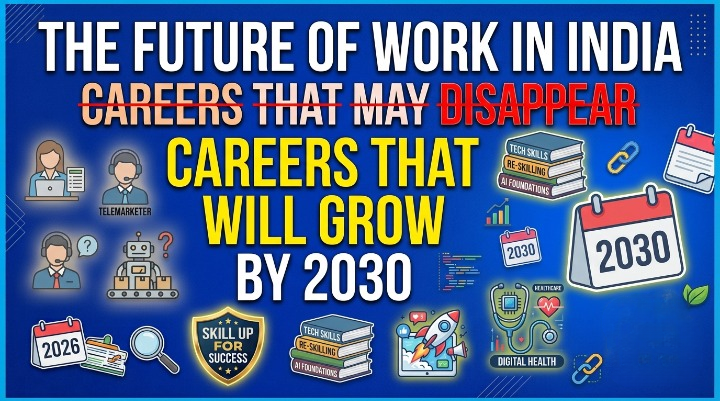
By 2030, the Future of Work in India will be shaped by rapid automation and the adoption of the AI world. Redefining the need for labor from everyday tasks to more technical and people-oriented jobs. “The risk of decline is severe for repetitive administrative, data-entry and basic customer service jobs, but there will be huge job growth in sectors like data science, green energy, cybersecurity and advanced healthcare systems.
Technological evolution as a driver: Macro drivers of the future of work in India
The digital transformation across all industries is a key change in the country’s employment landscape. So knowing these structural macro trends allows professionals to spot workplace changes on the horizon. The knowledge of cloud computing, fast internet access and local AI models is radically transforming traditional business operation paradigms and how companies hire talent.
The rapid, massive growth of digital infrastructure across both urban and rural areas is accelerating the impact of AI on jobs in India. From manufacturing to financial services, industries are adopting machine learning to reduce operational efficiency. It makes a clear separation between the traditional operational roles and the new technology oriented roles.
As smart systems become affordable, automation and the future workforce become more affordable and cheap. Companies use smart algorithms to handle routine customer queries, process huge volumes of financial transactions and manage supply chains. This mechanical integration eliminates human error and forces a dramatic reallocation of corporate human capital.
Hence, the pace at which employers can shift to technology first operating models is highly contingent on organizational survival. The affordability of technology is no longer a premium option for businesses but a baseline need. This structural shift is the bedrock of all emerging labor trends and future jobs in India 2030 across the subcontinent.
Industry Sectors That Will No Longer Exist in India by 2030
As we know, companies like Anthropic softwares and Automation are going to reduce the demand for workers in labor data management jobs in India. Professionals can move away from the high risk fields by looking at these declining areas. Software programs and robotic equipment can now perform routine operational tasks faster and with fewer errors than human workers.
Certain fields shrink day by day as standard tasks are taken over by software platforms. “In the next decade, the biggest jobs that will go away in India will be traditional data entry clerks, basic bank tellers and low end tech support agents. These are positions with predictable patterns that algorithm models can easily skilled up and learn.
In addition, automated translation tools and generative engines directly threaten entry level content production. Basic technical writing and standard document verification jobs are fast disappearing. These shifts show how automation is creeping into clerical and creative jobs, impacting the future of jobs in India 2030.
The same trend is seen in retail sectors with the implementation of automated checkouts and inventory tracking software tools. As supermarkets and logistics centers roll out automated tracking systems, cashiers and inventory clerks are not required. Workers on these vulnerable tracks today must be able to identify these patterns to protect their long-term livelihood.
Future Growth: Jobs That Will Be Needed by 2030
The jobs that also produce new and dynamic fields of economic activity, many of which are based on advanced technologies, sustainability and specialized human services. By identifying these new career opportunities, new candidates can explore future career opportunities in India and align their training with the market needs. Large investments into digital tech, transitioning to clean energy and modernizing infrastructure are fueling strong hiring demand across the country.
The technology careers that will be in demand by 2030 are Data scientists, machine learning engineers, and cybersecurity specialists are spearheading this hiring boom. Organizations will need these specialized professionals to safeguard corporate digital networks, analyze user data, and create localized algorithmic tools.
Meanwhile, the surge of green energy initiatives is bringing a deluge of new careers in India 2030. Recruitment numbers are soaring for solar power engineers, sustainability consultants and electric vehicle technicians. India’s commitment to cutting carbon emissions ensures long-term capital investment and stable hiring trends in these eco-centric sectors.
In the future, high-demand careers will include advanced healthcare and specialized eldercare. Demographics are changing and medical technology is advancing, so there’s a growing demand for biomedical engineers and specialized digital health coordinators. The flexibility of these roles is due to the high level of physical dexterity and human empathy they require.
Strategic Upskilling: Practical Frameworks for The Future of Work in India
To survive the coming shift in the job market, you need to strategically build a set of rock-solid professional capabilities. Workers need to intensely focus on talents that can’t be automated to ensure a stable long-term employment. Technical know-how and solid analytical skills together ensure that professionals remain valuable assets as corporate software architectures continue to evolve at a rapid pace.
To land AI-proof jobs in India, it is important to build specialized, non-routine skills. Jobs that require complex negotiation, deep emotional intelligence and cross-functional problem solving are highly immune to computer automation. Algorithms can’t easily replicate human management of relationships or the delicate leadership required to steer diverse corporate teams through systemic crises.
Professionals need to know what specific skills are required for the jobs of the future to remain competitive. The balance is to marry digital literacy, such as simple data analysis or prompt engineering, to core human soft skills. Lifelong upskilling programs are shifting from a luxury add-on to a necessary tool for career maintenance.
Now think of a practical application of this upskilling transition. Marketing analysts used to create spreadsheets manually, but automated dashboards made their job redundant. This professional moved into a strategic growth engineer role by learning data visualization and predictive modeling, showing how proactive learning creates outstanding future career opportunities in India.
A Contrarian View: Why Technology alone will not Power India’s Future of Work
Popular predictions today often overestimate the pace and uniformity of technology’s displacement of people across different developing economies. “Look at infrastructure barriers and economic realities and the timeline for employment evolution is far more complex. Structural financial constraints and regional differences often slow down the large-scale deployment of advanced automated business solutions.
A common fallacy is that the existence of an automation technology will automatically lead to the replacement of human workers across the country. This belief does not take into account the economic realities of India where cheap labor often makes the huge capital expenditure of installing complex robotic systems untenable. Smaller companies generally prefer flexible human teams to rigid digital tools.
Total displacement by technology requires ubiquitous internet access, reliable grid electricity, and extensive regional tech support. In many tier-2 and tier-3 locations, the infrastructure gaps naturally create a protective cover for localized traditional occupations.
So the workforce transition is going to be a very uneven one, rather than a sweep. Professionals shouldn’t panic about total displacement, but prepare for hybrid configurations where human intelligence works alongside machine models. This regional nuance, understood, saves you from making rash career decisions that could backfire and helps you make smart, targeted steps toward growing your skillset.