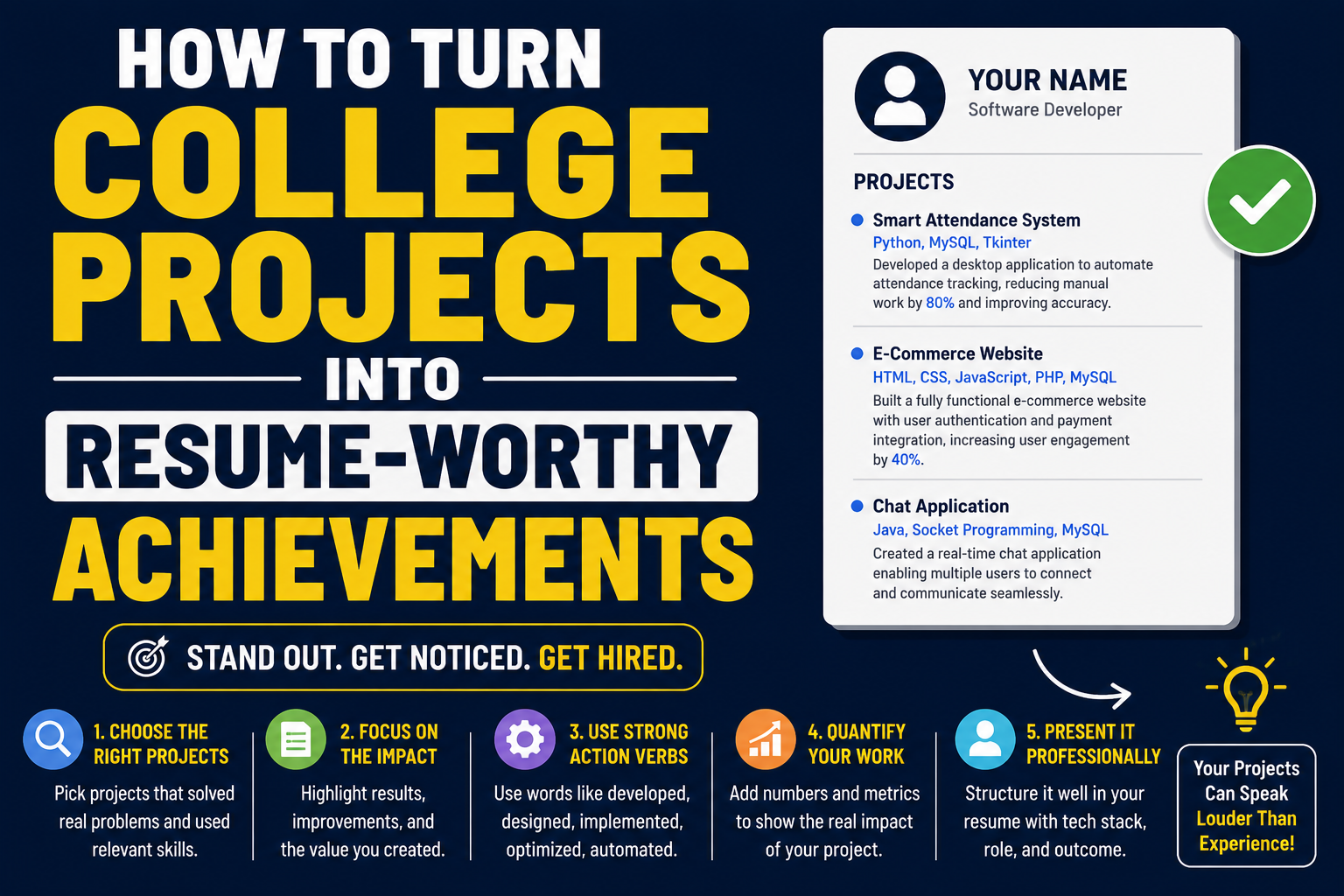
Every college student hits a wall when building their resume. You have attended classes, submitted assignments, and maybe even led a group project. Yet your resume still looks empty. No internship. No work experience. Nothing that feels impressive enough.
Here is the truth that most people do not tell you: college projects can be just as powerful as internship experience on your resume. The only difference is how you present them.
Recruiters are not just looking at where you worked. They are looking for proof that you can think, solve problems, and deliver results. A well-presented college project does exactly that.
Why College Projects Matter More Than You Think
When companies hire college students, they know you do not have years of work experience. What they are actually checking is whether you can apply what you know to real situations.
A college project, when framed correctly, shows that you identified a problem, worked through a solution, and produced something valuable. That is exactly what professionals do every day at work.
The difference between a project that impresses and one that gets ignored is not the complexity of the work. It is the way you communicate its value.
Step 1: Choose Projects That Solved a Real Problem
The first thing to check before selecting a project is whether it had a real purpose beyond getting a grade.
Did it help a group of people? Did it automate something that was previously done manually? Did it answer a question that had not been answered clearly?
Projects built around real problems always look stronger on a resume than purely academic exercises. Think about your college club struggling with registrations. Think about a business that had no inventory tracking system. Think about an NGO collecting data on paper.
If your project solved any real problem like these, you already have something worth talking about.
If you are still planning a project, choose one that aligns with the skills you want to showcase. If you are targeting data-related roles, build something involving data analysis. If you want to work in marketing, run a content experiment and measure the results. Design your college project as if it were your first professional assignment—because that is exactly how recruiters will view it.
Step 2: Structure It Like a Professional Work Sample
One of the easiest ways to make your college project resume-worthy is to give it a professional structure.
Include the following:
- A clear title with a one-line problem statement. Don’t just mention the project name. Explain what problem it solved.
- Your specific role. Mention whether you worked individually or in a team, and clearly describe your personal contribution.
- Tools, methods, and technologies used. List the software, frameworks, programming languages, or research methods you used.
- Outcome with measurable results. Include numbers wherever possible, such as time saved, users surveyed, or improvements achieved.
- Links to your work. Add a GitHub repository, demo, portfolio, case study, or walkthrough video.
Step 3: Write It the Right Way on Your Resume
The best way to present a college project on your resume is by using the Challenge → Action → Result approach.
Here is an example:
Weak: “Created a data dashboard for a college project.”
Strong: “Built a sales dashboard using Python and Tableau for a simulated retail dataset, improving data interpretation speed by 50% compared to manual spreadsheet analysis.”
The stronger version clearly explains what you built, the tools you used, and the outcome you achieved.
Use this structure for every college project on your resume. Keep it concise, specific, and results-oriented.
Step 4: Document the Process So You Can Explain It During Interviews
A college project on your resume becomes a conversation during interviews. The better you document your work now, the more confidently you can explain it later.
While working on your project, save your notes, drafts, early designs, unsuccessful attempts, and the reasoning behind important decisions.
After completing the project, write a README file or a short case study explaining what the project does, why you built it, the challenges you faced, and how you solved them.
This kind of documentation demonstrates professionalism and shows recruiters that you approach projects systematically.
Step 5: Publish and Make Your Project Visible
A college project that nobody can see adds limited value to your resume.
Publishing your work separates students who have portfolios from those who simply list project names.
Consider publishing your work by:
- Uploading your code to GitHub.
- Sharing design work on Behance or Figma.
- Publishing your research as a LinkedIn article.
- Recording a short project walkthrough video.
- Creating a simple portfolio website.
If you worked with a startup, college club, or nonprofit organization, ask them for a short testimonial or written feedback. Even a simple recommendation adds credibility to your work.
Real-world validation—even on a small scale—can transform a college project into a portfolio piece that competes with internship experience.
Final Words
Your college project does not need to be perfect. It needs to be purposeful, well-presented, and easy for a recruiter to understand within a few seconds.
Start with what you already have. Improve it, add measurable results, publish it, and present it like the achievement it truly is.