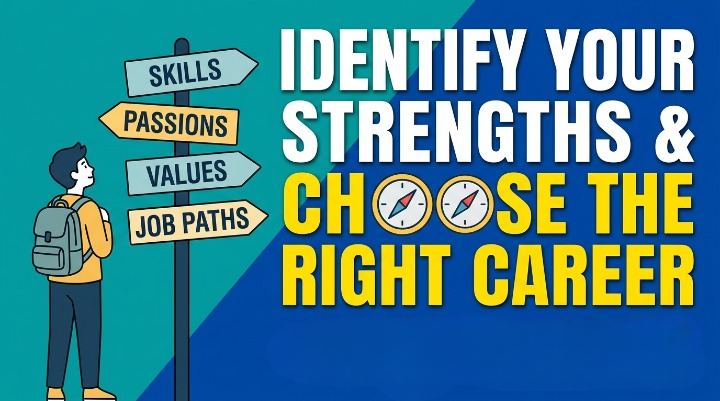
Research to learn how to identify your strengths and choose the right career path. Firstly assess your skills, apply structured updated tools and match your natural talents with practical industries. Aligning proven capabilities with industry needs ensures students and graduates secure sustainable, high growth long-term employment.
The Core Framework for Identifying Your Strengths and Choosing the Right Career Path
By analysing previous accomplishments and trustworthy feedback, professionals can find their potential. With the help of auditing their academic performance and outside evaluation, people can learn the art of knowing their strengths and making the right choice of their career.
This objective method ensures that candidates choose industries where their natural abilities will organically drive career success.
Proper professional mapping is based on hard evidence, not some guesswork. Students should write down their tasks so they can do quickly and well. Academic achievements, leading projects and solving technical problems are the best evidence of natural talent. Schools maximize discovery with early strategic career guidance for students.
Accuracy is improved with the collection of external data. Ask your professional mentors and peers for feedback on your work habits to discover hidden talents. A mix of personal signals and external feedback can produce a clear talent profile. Candidates can also have a specialised career aptitude test for students to verify these findings.
Once verified, close examination of relevant industries. Successful pros know to choose a career that plays to their strengths and interests, not outside trends. Discovering your strengths for a career will ensure that you are targeting roles that will bring you long-term satisfaction in your life.
Data-Driven Approaches to How to Recognise Your Strengths and Choose the Right Career Path
“Following your passion” is often the worst advice for job seekers. The best career strategy today is to choose a career that is based on strengths and interests and is backed by measurable market data. However, building a career on pure emotional enthusiasm and unknown capability can lead to under-employment and professional dissatisfaction in the career lifecycle.
Traditional wisdom advises graduates to pursue hobbies and passion, but passion is not talent. For example, a student may be passionate about digital media, but may not have the ability for technical aptitude for advanced software engineering.
Candidates should think about what are the key factors to consider when choosing a career to mitigate this risk. Market demand, daily operational tasks and economic stability should influence the final decision. By focusing on choosing a career based on strengths and interests, graduates are less likely to enter declining employment sectors.
Refining your approach by looking at sorted facts. Knowing how to select the right career path is about finding that balance between what you enjoy and what is practical. Job seekers who match accurate competencies with economically viable industries accelerate their professional growth. When mastery of technical tasks is recognised, real career satisfaction is achieved.
Using Structured Metrics in Career Planning for Students
Scientific assessment tools clarify early professional development.
The use of intuition in transition periods of education may lead to a professional mismatch in the long run. The employment of a validated career aptitude test for students applies empirical data to the decision-making process. These tests test cognitive strengths, logic processing speeds, and behavioural preferences so candidates can efficiently sort through potential job titles.
Personality type can reduce professional friction by finding workable career options. Introverts with an analytical bent tend to thrive in a structured research setting, while extroverted personalities do well in a collaborative corporate strategy environment.
Recognising these behaviour dynamics early protects candidates from toxic work cultures.
The comprehensive career assessment and career planning frameworks close the gap between academic education and corporate employment. Students who plan their early career have high graduation-to-employment placement ratios. These structured diagnostic resources allow young professionals to make informed, data-driven decisions that will ensure a stable financial future.
Real World Implementation: Mapping an Optimal Career Path for Students
To translate self-knowledge into employment there is a multi-step execution plan that must be followed.
The best way to help students figure out their career path is to start practical experiments such as informational interviews, internships, and skill-building projects. These kinds of activities can help confirm if an industry chosen aligns with a candidate’s hands-on skills and day-to-day lifestyle preferences.
Consider an undergraduate student Jasmine majoring in Economics. Jasmin was good at analysis, but she didn’t know what she wanted to do after graduation. Instead of randomly selecting a job, she began a full-scale career assessment and career planning process to align her core competencies to data analysis and strategic corporate consulting.
Jasmine took a short summer internship at a local logistics company to test the waters. This experience enabled her to apply data-modeling skills to real supply-chain problems. The hands-on environment confirmed that Jasmine liked sorting analytical data but did not like isolated laboratory research, which helped Sarah eliminate wrong options quickly.
Sarah also used institutional career guidance for students to meet with industry professionals. Sarah found out what it’s really like to be a financial analyst with a series of short informational interviews. This clear framework demonstrates how purposeful career planning for students leads to predictable employment success, bringing the abstract to life in very rewarding corporate placements.
Strategic Assessment: How to Discover Your Strengths and Choose the Right Career Path
Having a long-term career which is secure depends on your personal attributes. Being aligned with market growth sectors is very important. Have a look at the ongoing industrial transformations, technological updates and specialised job requirements to choose the right career option. This forward-looking approach ensures that new graduates are placed into growing economic sectors with the potential for sustained career growth.
The world of work is rapidly changing. Future-oriented is the key to finding the best career path for students. Candidates should find out what sectors are being given capital investments and what new job roles are being created. Aligning your skills with growing industries will help prevent skills obsolescence down the road.
Like candidates exploring potential careers, they should know how to identify your strengths for a career that will keep automation alive. Creative problem solving, emotional intelligence and complex system management are still safe from the threat of being taken over by advanced technology. These tough skills are taught so that you stay relevant in many different corporate environments.
In the end, a career choice for life involves a compromise between inner abilities and outside realities. Candidates should take into account all the key factors to consider when selecting a career, such as work-life balance and growth potential of wages.
This comprehensive analysis ensures students and graduates make sustainable choices and provides the solid foundation for lifelong economic independence.